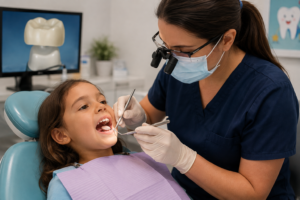
Kids’ dental emergencies rarely happen at a convenient hour. A scooter spill at the park, a hard bite on an ice cube, a toothache that starts at 11 p.m. What you do in the first 30 minutes often decides whether a tooth survives.
This guide gives you the exact steps for each situation and tells you when to call a kids emergency dentist.
Key Takeaways
- Act within 30 minutes for a knocked-out permanent tooth. Pick it up by the crown, rinse it gently, and store it in milk. The faster it gets back in the socket, the better the odds.
- Never put a knocked-out baby tooth back. Replanting it can damage the permanent tooth forming underneath. Control the bleeding and call your pediatric dentist.
- Treat facial swelling as urgent. Swelling around the eye, jaw, or neck, plus fever, means infection is spreading. Call the same day or go to the ER.
- Dental injuries are common. A meta-analysis of studies worldwide put the prevalence of traumatic dental injuries in children and adolescents at about 17.5 percent, with falls as the leading cause and home as the most frequent location.
- Save the number before you need it. Save your pediatric dentist’s number in your phone today. Parents who call within the hour get better outcomes than parents who wait until morning.
- Prevention works. A custom mouthguard for sports and a quick childproofing pass at home cut your risk of the most common pediatric dental emergencies.
What Are Pediatric Dental Emergencies?
A pediatric dental emergency is any injury or symptom in your child’s mouth that needs treatment within hours, not days. The test is simple. Ask whether waiting will cost your child a tooth, cause lasting damage, or leave them in pain they cannot manage.
Some situations look dramatic and turn out to be minor. A lip that bleeds heavily often stops within ten minutes. Other situations look mild and need fast care. A small chip with a pink dot in the center means the nerve is exposed, and that tooth needs attention the same day.
Three questions help you sort it out fast. Is there uncontrolled bleeding? Is a permanent tooth loose, pushed out of place, or missing? Is there swelling in the face or neck? A yes to any of these means you should call for kids’ dental urgent care right away.
What Are the Four Common Dental Emergencies in Children?
Most calls to a pediatric dentist fall into four categories. Learn these four, and you will handle most real-life situations.
Knocked-Out Tooth
A knocked-out tooth is the most time-sensitive emergency on this list. For a permanent tooth, the target window is 30 to 60 minutes. Handle the tooth by the crown (the white part you normally see), and avoid touching the root.
If the tooth is dirty, rinse it for about ten seconds under cool running water or milk. Do not scrub it, do not use soap, and do not dry it. The cells on the root surface need to stay alive.
If your child is old enough to cooperate, place the tooth back into the socket and have them bite gently on a clean cloth. If that is not possible, store the tooth in cold milk. Saliva works as a backup, and plain water is the worst option because it damages the root cells.
Baby teeth follow a different rule. Never replant a knocked-out baby tooth. Pushing it back can injure the permanent tooth bud sitting above it. Apply gentle pressure with clean gauze to stop the bleeding and call your pediatric dentist for an exam.
Chipped or Broken Tooth
A chipped or broken tooth is the injury parents see most often, and the right response depends on how deep the fracture goes. Rinse your child’s mouth with warm water and apply a cold compress to the cheek to limit swelling.
If you can, find the broken piece and bring it with you. Store it in milk the same way you would store a knocked-out tooth. Some fractures can be bonded back together.
Look at the broken surface in good light. A white or yellow surface usually means the chip is limited to enamel and dentin. A pink or red dot in the middle means the pulp is exposed, which hurts and needs same-day treatment to protect the nerve.
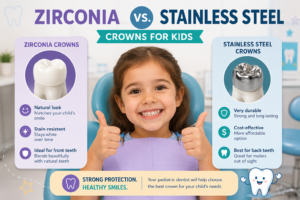
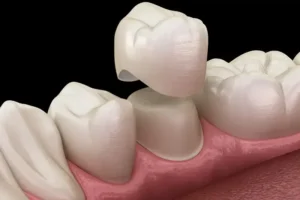
Larger breaks in back teeth often need a dental crown to restore chewing function and seal the tooth. Pediatric crowns are designed for small mouths and can be placed in one visit.
Severe Toothache or Swelling
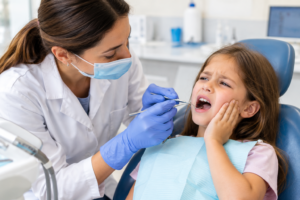
A toothache that wakes your child at night, lasts more than a day, or comes with a fever points to infection. Rinse with warm salt water, use a cold compress on the outside of the cheek, and give age-appropriate pain medication based on your child’s weight.
Skip two common mistakes. Do not place aspirin or any pill directly against the gum, because it burns the tissue. Do not use heat on a swollen cheek, because warmth can help the infection spread.
Facial swelling changes the urgency level completely. Swelling that closes the eye, spreads toward the neck, or comes with difficulty swallowing or breathing is a medical emergency. Go to the emergency room.
Soft Tissue Injuries
Soft tissue injuries involve the lips, tongue, cheeks, and gums. They bleed a lot because the mouth has a rich blood supply, which makes them look worse than they usually are.
Rinse with cool salt water, then press a clean piece of gauze on the wound for 10 to 15 minutes without lifting it to check. A cold compress on the outside of the lip reduces swelling and slows bleeding.
Call for care if bleeding continues past 15 minutes of steady pressure, if the cut goes through the border of the lip, if the wound gapes open, or if your child bit through their tongue. Those wounds often need stitches.
What Should I Do If My Child Needs Urgent Dental Attention?
Stay calm and work the steps in order. Your child reads your face before they feel the pain, so a steady voice helps.
- Stop the bleeding with firm, continuous pressure using clean gauze.
- Find and protect any tooth fragments, storing them in milk.
- Apply a cold compress to the outside of the cheek for 10 to 15 minutes.
- Give weight-based pain medication if your child is uncomfortable.
- Call your pediatric dentist and describe what happened and what you see.
Use this table to match the situation to the right timeline.
| Situation | What to do first | How fast to act |
| Permanent tooth knocked out | Rinse gently, replant or store in milk | Within 30 to 60 minutes |
| Baby tooth knocked out | Pressure with gauze; do not replant | Same day |
| Chip with pink center showing | Rinse, cold compress, save the piece | Same day |
| Small chip, no pain | Rinse, smooth edge check | Within a few days |
| Toothache with fever or swelling | Cold compress, pain relief, call now | Same day or ER |
| Lip or tongue cut still bleeding | 15 minutes of steady pressure | Same day if bleeding continues |
| Tooth pushed out of position | Leave it alone, soft foods only | Within hours |
Dental Office or Emergency Room?
Parents in Hallandale Beach often ask which door to walk through. The answer depends on whether the problem is limited to the teeth or involves the airway, the head, or heavy bleeding.
| Go to your pediatric dentist | Go to the emergency room |
| Knocked-out or loosened tooth | Suspected broken jaw or facial fracture |
| Chipped or fractured tooth | Loss of consciousness after the injury |
| Toothache without facial swelling | Swelling that affects the eye, neck, or breathing |
| Lost filling or crown | Bleeding that will not stop after 15 minutes |
| Abscess with mild local swelling | High fever with a spreading infection |
Call the dental office even when you head to the ER. Hospitals stabilize your child, and the tooth itself still needs a dentist afterward.
Dental Rules Parents Hear About
What Is the 3-3-3 Rule for a Toothache?
The 3-3-3 rule describes an ibuprofen schedule used for adult dental pain. It means taking three 200 mg tablets three times a day for up to three days to control the inflammation behind most toothaches. This is a home guideline, not an official clinical standard.
This rule does not transfer to children. Pediatric ibuprofen dosing is based on body weight, and a fixed 600 mg dose is unsafe for a small child. Use your pediatrician’s weight-based dosing chart, and treat any toothache that needs three days of medication as a reason to book an exam.
What Is the 7-4 Rule in Pediatric Dentistry?
The 7-4 rule tracks baby tooth eruption. The first primary tooth usually appears around 7 months, and roughly four more teeth arrive every four months after that. By age 3, most children have all 20 baby teeth.
The rule gives you a rough map rather than a deadline. A variation of six months in either direction is normal. Ask your pediatric dentist if no tooth has appeared by 18 months.
What Is the Rule of 7 in Pediatric Dentistry?
The phrase gets used loosely, and parents hear it in two different ways. Some use it as shorthand for the 7-4 eruption pattern described above. Others use it for the orthodontic milestone, since the American Association of Orthodontists recommends a first orthodontic check-up by age 7, when enough permanent teeth have arrived to spot bite problems early.
The useful takeaway sits elsewhere. The American Academy of Pediatric Dentistry recommends a first dental visit by the first birthday, or within six months of the first tooth. Early visits catch problems that later turn into emergencies.
How to Prevent Kids’ Dental Emergencies
You cannot childproof everything, and you can remove the most predictable risks. Falls cause most dental injuries, and most happen at home.
- Get a custom mouthguard for basketball, soccer, skateboarding, and any contact sport. Store-bought versions fit poorly and get spit out.
- Skip ice chewing and hard candy. These cause a large share of cracked molars in school-age kids.
- Secure furniture and pad sharp edges for toddlers, who take most of their falls between 18 and 36 months.
- Treat small cavities early. Most midnight toothaches start as a cavity someone decided to watch.
- Keep preventive visits every six months. Sealants and fluoride lower the odds of the infections that drive emergency calls.
Build a Dental Emergency Kit
Keep a small kit in your car and another at home. You will not want to search for supplies while your child is crying.
- Sterile gauze pads and a clean cloth
- A small sealed container with a lid for a tooth or fragment
- A single-serve shelf-stable milk box
- An instant cold pack
- Children’s ibuprofen with a dosing syringe
- Your pediatric dentist’s phone number written on the lid
Summary
Kids’ dental emergencies feel chaotic in the moment, and they follow predictable patterns. Knocked-out teeth need speed and milk. Chips need the broken piece and a same-day look if the center shows pink. Toothaches with swelling need a phone call, never a wait-and-see night.
Save your pediatric dentist’s number now, keep a kit in the car, and book the six-month visits that prevent most of these calls.
Glowing Smiles Pediatric Dentistry serves families across Hallandale Beach, FL, with preventive care, dental crowns, and gentle treatment for infants and kids.