If you think your child is terrified of the dentist, you are in good company. Research puts dental fear and anxiety at roughly 30 percent among children ages 2 to 6. Fear at this age responds well to the right approach. This guide explains what drives the fear and gives you specific steps you can use starting today.
Key Takeaways
- Dental fear is common and treatable. About 30 percent of children ages 2 to 6 show dental fear and anxiety, and rates drop to around 13 percent by adolescence.
- Book the first visit early. Children with no prior dental visit have higher odds of developing fear. An easy checkup at age 1 builds familiarity before any treatment is needed.
- Change how you talk about it. Skip words like shot, drill, and pain. Use short, neutral language and let the dental team introduce their own vocabulary.
- Schedule mornings. Book appointments after a full night of sleep and a light meal, when your child has the most emotional reserve.
- Ask about behavior guidance before sedation. Tell them that distraction and nitrous oxide resolve most cases without deeper sedation.
- Verify sedation safety standards. National guidelines call for at least two specifically trained people present during deep sedation, including an independent observer certified in Pediatric Advanced Life Support.
Why Is My Child Scared of the Dentist?
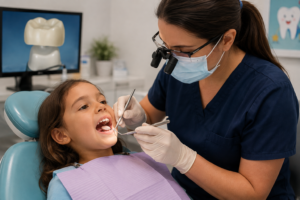
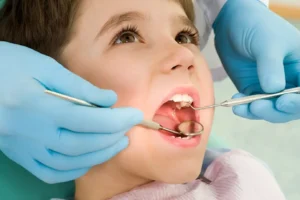
Most children fear the unknown more than they fear the treatment. A dental office presents bright lights, unfamiliar sounds, a reclining chair, and a stranger reaching toward their face. Your child has no reference point for any of it.
A 2024 systematic review found that children who had never visited a dentist had significantly higher odds of dental fear than children who had. Familiarity lowers fear. Avoidance raises it.
Fear also travels between people. Children read your tone, your posture, and your word choice. If you dread dental visits, your child learns to dread them too.
Common Triggers by Age
| Age | Main Trigger | What Helps Most |
|---|---|---|
| 1 to 3 years | Separation from you and strangers | Knee-to-knee exams, you stay in view |
| 3 to 5 years | Loud sounds and losing control | Tell, show, do, letting them hold a mirror |
| 6 to 9 years | Fear of pain and needles | Honest, simple explanations, distraction |
| 10 and up | Embarrassment and gagging | Privacy, headphones, a signal to pause |
Kids Dental Phobia Versus Normal Nervousness
Nervousness fades once the appointment starts. Kids’ dental phobia persists and escalates. Knowing the difference tells you how much support your child needs.
Watch for these signs of a deeper problem:
- Stomachaches or sleep trouble in the days before an appointment
- Crying or panic that starts in the parking lot
- Refusing to open their mouth at all, even for a count
- Gagging or vomiting triggered by the chair
- Fear that carries over to doctors, haircuts, and other appointments
Two or more of these signs mean your child needs a structured plan. Repeated forced visits tend to deepen the fear.
How to Help a Child With Fear of the Dentist Before the Visit
Preparation does more work than anything that happens in the chair. Start about three days out. Earlier than that gives anxiety time to build.
- Read books and watch short videos about dental visits so the setting looks familiar.
- Play dentist at home. Count your child’s teeth with a toothbrush, then let them count yours.
- Book a morning slot. Tired children have fewer coping resources by afternoon.
- Feed a light meal beforehand. Hunger lowers frustration tolerance.
- Bring a comfort object. A stuffed animal or blanket gives your child something familiar to hold.
- Request a meet and greet visit. Your child sits in the chair, meets the team, and goes home with no treatment.
Words to Use and Words to Skip
| Skip This | Say This Instead |
|---|---|
| It will not hurt | The dentist will count your teeth |
| Shot, needle, drill | Sleepy juice, tooth cleaner |
| Be brave | You can hold my hand the whole time |
| If you behave, you get a toy | We will pick out a sticker after |
The phrase it will not hurt introduces the idea of pain. Your child hears the word hurt and stops listening to the rest.
What Should I Do If My Child Cries at the Dentist?
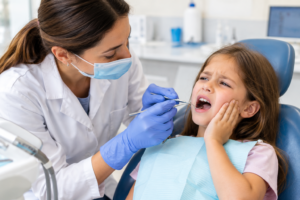
Crying is communication. Your child is telling you they feel overwhelmed. Your response in that moment shapes every future visit.
Stay calm and keep your voice low and steady. Children match the emotional temperature of the adults around them. Rushing to soothe with a raised, urgent tone signals that something is wrong.
Let the dental team lead. Pediatric teams train specifically for this, and they use pacing and language that parents rarely have on hand.
Ask for a short pause instead of pushing through. A two-minute break to sit up, take a sip of water, and reset often saves the appointment.
Agree on a stop signal before treatment begins. Raising one hand means pause. Giving your child a way to stop the procedure restores their sense of control, and most children use the signal far less than parents expect.
How to Calm a Child Down at the Dentist
Pediatric offices use specific behavior guidance techniques. Ask which ones your dentist uses.
Tell Show Do
The dentist explains each step in simple words, demonstrates the instrument on a finger or a model, then performs the step. This removes surprise, which drives most fear responses.
Distraction
Ceiling televisions, headphones, and conversation shift attention away from the mouth. Ask your child to count something or wiggle their toes on cue.
Voice Control and Positive Reinforcement
The dentist adjusts tone and pace to hold attention, then praises specific behaviors. Praise works better when it names the action, such as, “You kept your mouth open the whole time.”
Nitrous Oxide
Nitrous oxide, often called laughing gas, is the mildest pharmacological option. Your child stays awake, responds to questions, and breathes on their own. The effects clear within minutes after the mask comes off, and your child can return to school the same day.
Is It Safe for a Child to Be Sedated for Dental Work?
Sedation for dental procedures in children is generally safe when the office follows national standards. Safety depends on staffing, monitoring, and preparation rather than the medication alone.
The American Academy of Pediatrics and the American Academy of Pediatric Dentistry issued updated guidance requiring at least two individuals with specific training and credentials to be present during deep sedation or general anesthesia. One must serve as an independent observer with no other responsibilities, and both that observer and the treating dentist must hold Pediatric Advanced Life Support certification.
Comparing Sedation Options
| Option | Awareness | Typical Use | Recovery |
|---|---|---|---|
| Nitrous oxide | Fully awake | Mild anxiety, cleanings, fillings | 5 to 10 minutes |
| Oral sedation | Drowsy, responsive | Moderate anxiety, longer visits | Several hours |
| General anesthesia | Asleep | Extensive treatment, special needs, severe phobia | Rest of the day |
Is It Risky to Put a Child Under Anesthesia?
Every level of sedation carries some risk. General anesthesia carries the most, which is why it belongs in cases with clear clinical need rather than convenience. Ask these questions before you consent:
- Who administers the anesthesia, and what are their credentials
- Will a dedicated observer monitor my child throughout
- What monitoring equipment do you use, including capnography
- What are the fasting instructions, and when do they start
- What happens if my child has a medical event during the procedure
A practice that answers these clearly and in writing is following the standard of care. Hesitation or vague answers are your signal to seek a second opinion.
How a Pediatric Dentist Changes the Experience
A pediatric dentist completes two to three additional years of training focused on child development, behavior guidance, and treating small mouths. That training shows up in every part of the visit.
The physical space is built for children, with smaller instruments, shorter appointment blocks, and staff who expect tears and know how to work through them. Practices in Hallandale Beach and across South Florida that focus on children also schedule preventive visits so your child experiences easy appointments long before any treatment is required.
Prevention is the strongest anxiety tool available. Children with untreated cavities have higher odds of dental fear, so keeping your child cavity-free helps keep visits short and comfortable.
Summary
When your child is terrified of the dentist, the fear responds to preparation, honest language, and a team trained to work with anxious children. Start with a meet-and-greet visit, book mornings, and drop words like hurt and shot from your vocabulary.
Ask your dentist to use tell, show, do, and a stop signal before considering any sedation. Reserve deeper sedation for genuine clinical need, and confirm the office meets national staffing and monitoring standards.
Most children who start with positive, low-pressure visits grow into adults who keep their dental appointments. The work you do now protects your child’s oral health for decades.